

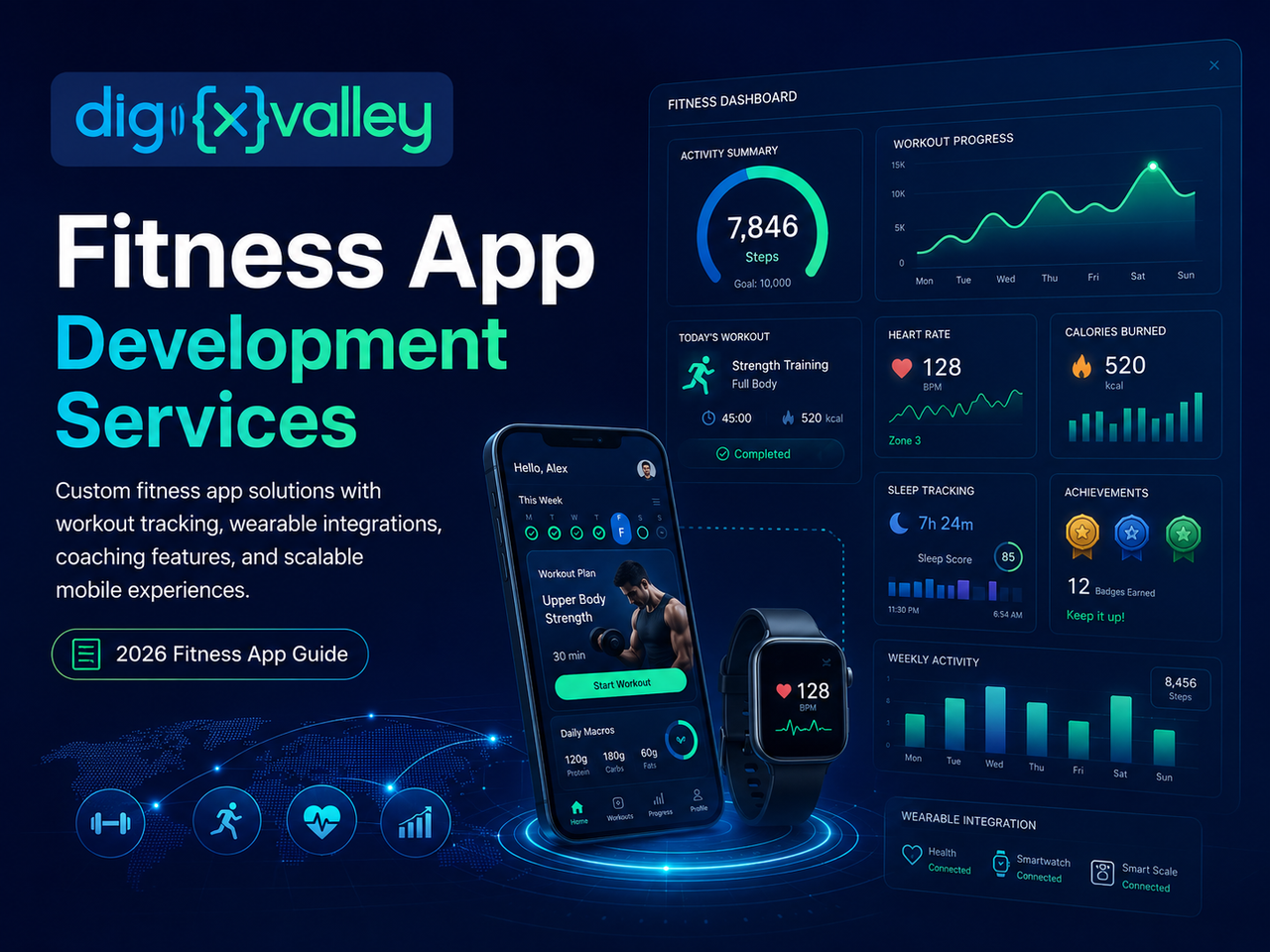
Fitness app development services have become essential for startups, gyms, wellness brands, and digital health businesses that want to launch custom mobile apps for workouts, progress tracking, wearable integrations, subscriptions, and AI-powered coaching. A successful fitness app is not built only around attractive screens; it needs the right features, secure architecture, user-focused design, analytics, and a scalable development roadmap. Whether you are planning a simple workout tracking app or a full-featured fitness platform, understanding the cost, timeline, MVP features, compliance needs, and technical trade-offs helps you make better product decisions before investing in development.
What Are Custom Fitness App Development Services?
Custom fitness app development services involve designing, building, testing, launching, and scaling a fitness or wellness application based on specific business goals and user needs.
Unlike white-label fitness apps, a custom fitness app gives your business full control over the product experience, features, architecture, user data flow, monetization strategy, integrations, and long-term scalability.
A custom fitness app may include:
- Personalized workout plans
- Exercise tracking
- Progress dashboards
- Nutrition tracking
- Wearable device integrations
- Subscription billing
- Push notifications
- Live coaching
- AI-based recommendations
- Computer vision form correction
- Community features
- Admin dashboards
- Analytics and retention tracking
For founders, CTOs, and product leaders, custom fitness app development is valuable because it allows them to build a product around their actual business model instead of forcing their business into a limited template.
Why This Guide Matters for Founders and CTOs
Most fitness app development discussions focus only on visible features such as workout screens, progress charts, and user profiles. However, the decisions that affect cost, launch speed, scalability, and long-term product stability are usually technical.
Before hiring a fitness app development company, you need clear answers to these questions:
- Which features should be included in the MVP?
- Which features can be delayed until version two?
- Should the app be cross-platform or native?
- Should wearable integrations be built immediately?
- How much will AI personalization increase the budget?
- Does the app need HIPAA, GDPR, FTC, or FDA-related review?
- What analytics must be implemented from day one?
- Which vendor can support post-launch scaling?
A good development partner does not simply build screens. A good partner helps you make strategic product, architecture, security, and budget decisions before the first sprint begins.
Fitness App Features That Actually Move KPIs
Not every feature improves retention or revenue. A fitness app can look impressive but still fail if users do not return, complete workouts, track progress, or upgrade to paid plans.
The best MVP should focus on features that directly support user habit formation.
Core Retention Features
Core retention features help users return to the app consistently.
These include:
- Personalized workout plans
- Workout logging
- Visible progress tracking
- Streaks and milestones
- Push reminders
- Weekly goals
- Basic performance analytics
These features are usually easier to build than advanced AI or live streaming video features, but they create the strongest foundation for early validation.
Revenue Features
Revenue features help convert engaged users into paying users.
These include:
- Subscription plans
- Premium workout programs
- Paid coaching
- In-app purchases
- Nutrition product commerce
- Community membership access
- Corporate wellness packages
Subscription billing should be planned carefully because it requires payment gateway integration, tax handling, user access logic, renewal flows, cancellation flows, and webhook synchronization.
High-Cost Differentiators
Some features can make the product stand out, but they also increase cost and complexity.
These include:
- AI workout personalization
- Computer vision form correction
- Real-time live coaching
- Low-latency video sessions
- Wearable telemetry dashboards
- Predictive health insights
- Advanced nutrition recommendations
These features should usually be added after the app has validated retention and revenue signals.
Recommended MVP Strategy
The best fitness app MVP should be narrow, useful, and measurable.
A practical MVP can include:
- User registration
- Profile setup
- Workout categories
- Workout plan selection
- Exercise logging
- Progress tracking
- Push notifications
- Basic analytics
- Admin content management
- Subscription-ready architecture
This MVP can validate whether users complete workouts, return weekly, respond to reminders, and engage with progress data.
A common mistake is building wearable sync, AI coaching, live video, and marketplace features too early. This can double the development budget before the team has confirmed whether users want the core product.
A better approach is to launch a lean MVP first, study the data, and then invest in advanced features after user behavior proves demand.
Fitness App Architecture and Technical Trade-Offs
The technical architecture of a fitness app determines how easily the product can scale, integrate with wearables, handle user data, and support future features.
Lightweight MVP Architecture
A lightweight MVP architecture is best for startups that want fast market validation.
It may include:
- Cross-platform mobile app using React Native or Flutter
- Serverless backend
- Firebase or AWS services
- Third-party authentication
- Basic cloud database
- Push notification service
- Payment gateway integration
- Basic analytics events
This option is usually faster and more affordable. It is ideal when the goal is to test product-market fit quickly.
Integrated Wearable Architecture
A wearable-ready architecture is best for apps that depend on activity tracking, step count, heart rate, sleep data, calories, or connected health data.
It may include:
- Apple HealthKit integration
- Android Health Connect integration
- Google Health API or cloud-based health data integration
- OAuth-based authorization
- Data normalization layer
- Secure data storage
- Analytics database
- Consent management
- Background sync logic
This architecture requires stronger planning because health and fitness data can come from different devices in different formats.
Advanced AI and Computer Vision Architecture
An AI-rich fitness platform requires more specialized infrastructure.
It may include:
- Machine learning models
- Labeled exercise datasets
- Video processing
- GPU-backed inference
- Edge inference options
- Model monitoring
- Human-in-the-loop validation
- Continuous retraining pipeline
- Advanced privacy and compliance review
This type of architecture is best for later-stage products or well-funded startups because AI features require continuous improvement, not just one-time development.
Fitness App Development Cost in 2026
Fitness app development cost depends on app complexity, platform choice, number of integrations, UI/UX depth, compliance requirements, team location, and post-launch support.
Estimated Cost by Product Type
Product Type | Estimated Cost | Timeline | Best For |
Lean MVP | $25,000 – $60,000 | 2 – 4 months | Startup validation |
Mid-Range Fitness App | $50,000 – $150,000+ | 4 – 6 months | Growth-stage product |
Enterprise Fitness Platform | $120,000 – $300,000+ | 6 – 9+ months | Large-scale platforms |
AI / Computer Vision Fitness App | $200,000 – $400,000+ | 6 – 12+ months | Advanced differentiation |
These ranges are general planning estimates. The final cost should always be calculated after feature scoping, user flow mapping, architecture review, and integration planning.
Feature Cost Impact Matrix
Feature | Cost Impact | Technical Notes |
User profiles | Low | Needed for personalization and tracking |
Workout logging | Low | Core MVP requirement |
Progress charts | Low to Medium | Requires clean data structure |
Push notifications | Low to Medium | Important for retention |
Subscription billing | Medium | Requires payment logic and webhook handling |
Wearable integrations | Medium to High | Requires data normalization and authorization |
Live coaching | High | Requires video infrastructure and scheduling |
AI personalization | High | Requires data, models, and testing |
Computer vision form correction | Very High | Requires video processing, datasets, and model training |
Hidden Fitness App Development Costs
Many founders only budget for visible app features. However, hidden costs can affect launch quality and long-term scalability.
Important hidden costs include:
- QA testing
- Security hardening
- Analytics setup
- Cloud hosting
- Third-party API fees
- App store preparation
- Legal and compliance review
- Maintenance after launch
- Bug fixing
- Performance monitoring
- Customer support tooling
As an internal planning allowance, teams may reserve an additional 20% to 30% for QA, security, analytics, and early post-launch improvements. The appropriate contingency depends on the product scope and delivery risks.
Compliance, Privacy, and Security Requirements
Fitness apps often collect sensitive personal information. Depending on the business model, market, and data relationships, the app may need legal and technical compliance planning.
HIPAA Considerations
HIPAA does not automatically apply to every fitness app.
HIPAA may apply when an app creates, receives, maintains, or transmits Protected Health Information on behalf of a HIPAA-covered entity or business associate, such as a covered healthcare provider or health plan. Workplace wellness programs require individual assessment because HIPAA applicability depends on how the program is structured.
A direct-to-consumer workout tracker may not be subject to HIPAA, but it can still have serious privacy and security obligations.
GDPR Considerations
If the app targets users in the European Union or processes EU user data, GDPR must be considered.
Health-related data can fall under special category data. This means the app may need explicit consent, data minimization, retention controls, deletion rights, and clear privacy notices.
FTC Health Breach Notification Rule
For U.S. health and wellness apps that fall outside HIPAA, the FTC Health Breach Notification Rule may apply when the product qualifies as a vendor of personal health records or a related entity and experiences a breach of unsecured identifiable health information.
FDA Considerations
Low-risk general wellness functions may fall outside active medical-device regulation. However, FDA oversight can become relevant when software is intended to diagnose, treat, mitigate, cure, or prevent disease or when it performs a regulated medical-device function.
A fitness app that tracks workouts is different from an app that claims to detect medical conditions.
Security Features Every Fitness App Should Include
A serious fitness or health app should include security from the first sprint.
Recommended controls include:
- Secure authentication
- Role-based access control
- Encrypted data transmission
- Encrypted sensitive data storage
- Consent tracking
- Secure API design
- Audit logs
- Privacy-first analytics
- Vendor data processing agreements
- Regular vulnerability testing
- Secure cloud configuration
- Clear data retention rules
Security is cheaper when it is built early. Retrofitting compliance and security after launch is usually more expensive and risky.
Wearable Fitness App Integrations
Wearable integrations can improve engagement because users can connect activity, sleep, heart rate, calories, and other health signals to their fitness experience.
Common integration options include:
- Apple HealthKit
- Android Health Connect
- Google Health API for cloud-based integrations
- Fitbit Web API
- Garmin
- Oura
- WHOOP
- Samsung Health
For Android, new projects should avoid building new dependencies on Google Fit. Google states that Google Fit APIs will be supported only until the end of 2026 and recommends Health Connect for mobile-first integrations or the Google Health API for cloud-based use cases.
For iOS, HealthKit requires user permission for each health data type the app wants to read or write.
The engineering team should avoid storing raw wearable data without a clear reason. A better approach is to create a normalized data layer that only stores the data needed for product features and analytics.
Analytics and Growth Instrumentation
A fitness app should not launch without analytics.
Without analytics, the team cannot understand why users leave, which workouts perform best, which features increase retention, or which acquisition channels bring valuable users.
Minimum Analytics Events
Track these events from day one:
- Account created
- Profile completed
- Workout plan selected
- Workout started
- Workout completed
- Goal created
- Goal achieved
- Reminder opened
- Subscription screen viewed
- Trial started
- Subscription purchased
- Subscription canceled
Important Fitness App KPIs
Key KPIs include:
- Week-1 retention
- Week-4 retention
- Workout completion rate
- Average workouts per user per week
- Push notification open rate
- Trial-to-paid conversion
- Churn rate
- Lifetime value
- Customer acquisition cost
- Feature engagement rate
The strongest product teams use analytics to decide what to build next instead of relying only on assumptions.
13-Week Fitness App MVP Roadmap
A well-planned 13-week roadmap helps development teams validate the product quickly while keeping costs and scope under control. The timeline below outlines a practical approach for building a fitness app MVP.
Weeks 1–2: Discovery and Architecture
The team defines business goals, user personas, MVP scope, wireframes, technical architecture, database structure, APIs, compliance risks, and development milestones.
Weeks 3–4: Core Backend and Frontend
The team builds authentication, user profiles, workout content structure, basic app navigation, and core workout screens.
Weeks 5–6: Tracking and Engagement
The team adds workout logging, progress charts, push notifications, analytics events, and admin controls.
Weeks 7–8: Payments and Security
The team integrates subscriptions, access control, data protection, QA automation, and secure API testing.
Weeks 9–10: Beta Launch
The app is released to a controlled test group through TestFlight and Google Play testing. The team monitors bugs, retention, performance, and usability feedback.
Weeks 11–12: Refinement
The team improves UX, fixes bugs, tunes the database, strengthens performance, prepares app store assets, and finalizes production readiness.
Week 13: Public Release
The app is submitted to the Apple App Store and Google Play Store. Monitoring, analytics, support, and post-launch improvement cycles begin.
Recommended Fitness App Development Team
A lean MVP team usually includes:
- Product manager
- UI/UX designer
- 2 mobile app developers
- Backend developer
- QA engineer
- DevOps or cloud engineer
- Part-time security/compliance consultant
A more advanced fitness platform may require:
- Native iOS developer
- Native Android developer
- Backend engineers
- Data engineer
- Machine learning engineer
- Security specialist
- Product analytics specialist
- Dedicated QA automation engineer
The team should match the product stage. A lean MVP does not need the same team structure as an enterprise AI fitness platform.
Build vs Buy vs White-Label
Custom Development
Custom development is best when your business needs unique features, proprietary UX, scalable architecture, custom integrations, or long-term IP ownership.
It costs more upfront, but it gives you more control.
Component SDKs
Buying component SDKs is useful when you want to speed up specific features such as video calls, payments, analytics, or wearable sync.
This can reduce development time, but it may create vendor dependency.
White-Label Fitness App
A white-label solution is best for simple launches with limited differentiation.
It is faster and cheaper, but it limits brand control, feature flexibility, scalability, and long-term product uniqueness.
How to Choose the Right Fitness App Development Company
Choosing the right development partner is as important as choosing the right features.
A strong fitness app development company should provide:
- Fitness or health app portfolio
- Technical architecture documentation
- Transparent cost breakdown
- Clear sprint plan
- QA process
- Security process
- API integration experience
- Post-launch support
- Analytics implementation
- App store deployment experience
- Compliance awareness
Vendor Scorecard
Use this scorecard before hiring a vendor.
Criteria | Score |
Fitness or health app experience | 0–5 |
Architecture quality | 0–5 |
UI/UX capability | 0–5 |
API and wearable integration experience | 0–5 |
Security and compliance process | 0–5 |
QA and testing process | 0–5 |
Communication and sprint management | 0–5 |
Post-launch support | 0–5 |
As an internal screening benchmark, teams can consider shortlisting vendors that score 32 out of 40 or higher. The final decision should also consider references, portfolio quality, security practices, communication and contract terms.
Common Mistakes to Avoid
Overbuilding the MVP
Building too many features before validation increases cost and delays launch.
Start with the smallest useful version that can test retention.
Ignoring Analytics
Without analytics, you cannot make informed product decisions.
Implement event tracking from the first sprint.
Adding AI Too Early
AI features need data, testing, and maintenance.
Use rule-based personalization first if the product does not yet have enough user data.
Underestimating Wearable Integration
Wearable data is complex because every ecosystem handles data differently.
Plan for consent, normalization, sync errors, and privacy controls.
Treating Compliance as a Final Step
Compliance should be reviewed during discovery.
Waiting until launch can cause delays, rework, and legal risk.
Why Choose Digixvalley for Custom Fitness App Development Services?
Digixvalley helps businesses plan, design, develop, and scale custom fitness and health app products with a practical engineering-first approach.
Our team can help you with:
- Fitness app MVP planning
- UI/UX design
- Cross-platform app development
- Health and wearable integrations
- Subscription billing
- Backend development
- Admin dashboard development
- Analytics instrumentation
- Security-focused development
- App store launch support
- Post-launch scaling
Instead of building unnecessary features early, we help you create a phased roadmap that protects your budget and improves your chance of product-market fit.
Build Your Fitness App Fast. Grow With Data.
Final Takeaway
Custom fitness app development services are most successful when the product is built around clear user outcomes, measurable retention signals, secure architecture, and realistic budget planning. Start with a focused MVP. Build strong analytics from day one. Delay expensive AI, computer vision, and deep wearable features until the product has enough user data to justify them. The right development partner should help you make better product decisions, not just write code.
How much does it cost to build a custom fitness app?
A lean fitness app MVP may cost around $25,000 to $60,000. A mid-range product with subscriptions, analytics, and wearable integrations may cost $50,000 to $150,000+. Complex AI, computer vision, or enterprise platforms may exceed $200,000 and can reach $400,000+ depending on scope.
How long does it take to build a fitness app?
A focused MVP usually takes 2 to 4 months. A mid-range product may take 4 to 6 months. A complex AI, wearable, or enterprise platform may take 6 to 12+ months.
Should I build a native or cross-platform fitness app?
Cross-platform development with Flutter or React Native is usually best for MVPs because it reduces cost and launch time. Native iOS or Android development is better when the product requires deep device-specific functionality, advanced sensors, or high-performance video and AI features.
Does every fitness app need HIPAA compliance?
No. HIPAA does not automatically apply to every fitness app. HIPAA may apply when the app handles Protected Health Information on behalf of a covered entity or business associate. Consumer fitness apps may still need privacy, security, FTC, GDPR, or local data protection review.
Should my fitness app integrate with wearables?
Wearable integrations are useful if your product depends on activity, heart rate, calories, sleep, or health tracking data. However, they should be planned carefully because they increase development complexity, privacy requirements, and maintenance work.
Is AI necessary for a fitness app MVP?
AI is not necessary for most MVPs. A rule-based personalization system can be enough for early validation. AI should be added when the app has enough user data and a clear use case that improves retention or revenue.
What is the best MVP feature set for a fitness app?
A strong MVP should include user profiles, workout plans, workout logging, progress tracking, push reminders, basic analytics, and an admin dashboard. Subscription billing can be added if monetization is part of the first launch.
How do I choose the right fitness app development company?
Choose a company with relevant fitness or health app experience, clear architecture planning, transparent pricing, security knowledge, QA process, app store launch experience, and post-launch support.


