Services
Industries
Apps Development
Resources

Logistics

Healthcare

Automotive & Mobility

FinTech

PropTech

Education & EdTech

Manufacturing

Retail & eCommerce

Energy & Utilities

Home >Freight Management Systems Development

Freight Management Systems Development

Build or modernize freight software that connects shipment planning, carrier coordination, rates, documents, tracking, billing, and operational reporting around the way your freight operation actually works.

For freight forwarders, 3PLs, shippers, and operators with complex carrier networks, we design systems that integrate with ERP, WMS, carrier APIs, EDI, and customer-facing tracking without forcing every workflow into a generic product model.

Trusted by
turbo last mile
Foodage
Pickle ball manager
SwiftSub
Studentlearnx
Driblx
2019

Founded

45+

Technology Experts

200+

Digital Solutions Launched

50+

Enterprise Projects

10+

Countries Served

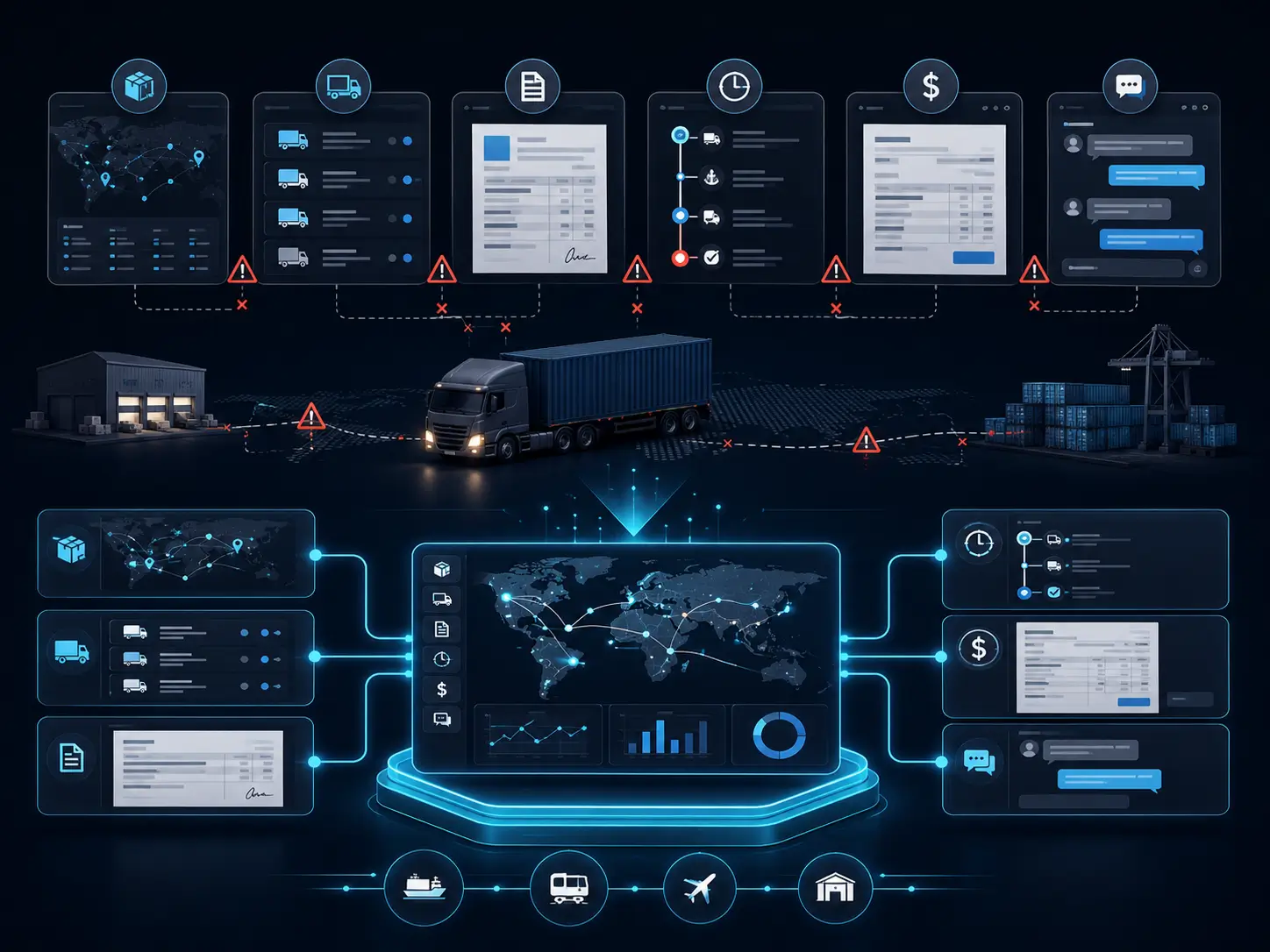
When Freight Operations Outgrow the Current Software

Freight software should solve operational friction, not simply digitize an existing spreadsheet. The strongest signals are usually visible in the handoffs between planning, carriers, documents, status events, billing, and customer communication.

When Freight Operations Outgrow the Current Software
01

Manual Shipment Planning

Loads, lanes, carrier choices, service levels, and shipment details may be planned across spreadsheets, email, and disconnected systems. This creates duplicate entry and makes it difficult to understand which version of a shipment record is authoritative.

02

Inconsistent Rates and Contract Logic

Carrier rates, surcharges, service rules, and negotiated terms can become difficult to apply consistently when pricing logic lives in documents or individual staff knowledge. A freight system can centralize the rules used to quote, plan, and review transportation costs.

03

Fragmented Carrier Visibility

Multi-carrier operations often receive tracking events from different portals, APIs, or EDI feeds. Without normalization, teams spend time reconciling statuses rather than managing exceptions.

04

Documents and Status Events Do Not Stay Aligned

Booking references, labels, manifests, delivery records, invoices, and shipment milestones can move through separate processes. When documents and status changes are disconnected, support and operations teams lose a reliable view of the shipment lifecycle.

05

Exceptions Are Managed Too Late

Delays, missed pickups, failed tenders, missing carrier events, damaged freight, and route changes need structured ownership. If exceptions surface only through calls or customer complaints, the system is reporting history rather than supporting operations.

06

Freight Billing Requires Manual Reconciliation

Quoted rates, actual charges, accessorial fees, carrier invoices, and customer billing may not match automatically. This creates avoidable review work and makes it harder to understand margin and shipment-level cost.

Freight Workflows a Custom Management System Should Control

A freight management system can cover the full transportation lifecycle or only the workflows that create the most friction. The correct scope depends on whether the business is a freight forwarder, 3PL, shipper, brokerage, carrier-led operation, or a multi-modal network.

Rate and Quote Management

Store carrier agreements, lane rules, service levels, surcharges, and pricing logic so teams can build quotes from controlled data rather than manual lookup. Complex operations may also require customer-specific margins, contract rules, or approval thresholds.

Shipment and Load Planning

Convert orders or shipping requests into shipments, loads, legs, and planned movements. The model should support the actual transport structure, including direct moves, consolidated loads, multi-stop routes, and multi-leg journeys.

Carrier Selection and Tendering

Apply operational and commercial rules when assigning freight to a carrier. Decisions may depend on lane, mode, service level, capacity, contract status, cost, historical performance, or customer commitments.

Booking and Freight Documentation

Manage the records and documents required to move freight, such as shipment references, labels, manifests, delivery documents, and internal instructions. The document model should remain connected to the shipment and its status history.

Tracking and Milestone Visibility

Normalize carrier events into a consistent shipment timeline so operations teams and customers can understand what has happened, what is expected next, and where an exception requires action.

Exception and Operations Management

Create workflows for delays, missing events, failed pickups, route changes, documentation issues, or other operational exceptions. Alerts are most useful when they are connected to ownership and next actions rather than displayed as passive notifications.

Freight Audit, Charges, and Reporting

Compare expected and actual freight costs, manage shipment-level charges, support invoice review, and produce reports across carrier performance, lane activity, service levels, exceptions, and transportation spend.

01

OMS and Order Sources

Order-management or commerce systems create the shipping demand. They should pass clean order, customer, destination, item, and service requirements into the transportation workflow rather than become the transport planning engine.

02

ERP

ERP usually remains authoritative for finance, customers, suppliers, purchasing, and other enterprise records. The freight platform exchanges shipment, cost, billing, and status information with ERP without replacing the complete business system.

03

WMS

Warehouse management software owns receiving, inventory, picking, packing, and shipment readiness. Once freight is ready to move, the WMS can pass weight, dimensions, destination, service requirements, and dispatch readiness into the freight system. warehouse management software

04

Freight Management / TMS

The freight layer plans and executes transportation: carrier choice, loads, routes or legs, tendering, documents, tracking, exceptions, and freight cost workflows. This is the core responsibility of this page.

05

Carrier Network

Carrier APIs and electronic data interchange (EDI) connect external transportation partners to the platform for bookings, tenders, shipment events, documents, and other structured exchanges.

06

Last-Mile Delivery

When a shipment moves into a dedicated final-mile network, last-mile software can own driver dispatch, delivery routes, proof of delivery, and customer delivery events rather than forcing those workflows into the freight system. For deeper final-leg workflows, see our last-mile delivery software.

Where Freight Software Fits Between ERP, WMS, OMS and Last-Mile Systems

Freight software should own transportation planning and execution without duplicating every function in the surrounding stack. Clear system boundaries reduce conflicting data and make integrations easier to maintain.

The Freight Data Model Behind Reliable Shipment Control

Freight software becomes difficult to trust when the data model treats every movement as one flat shipment record. A stronger model separates the commercial request, physical movement, carrier relationship, milestones, documents, and charges so each change has a clear place in the system.

Shipment Identity

A shipment should have a stable identity that survives carrier changes, partial moves, status updates, and document revisions. Customer-facing references can differ from internal or carrier references without losing the underlying relationship.

Loads and Legs

A single customer shipment may move through several legs or be consolidated with other freight. Modeling loads and legs separately allows the software to represent actual movement instead of assuming one origin-to-destination action.

Carrier and Service Context

Each movement should record the carrier, service level, lane, mode, booking or tender status, and operational rules that apply. This makes later tracking, billing, and performance analysis meaningful.

Rates, Contracts and Charges

Expected transport cost should be connected to the rate or contract logic that produced it. Actual carrier charges and customer billing can then be compared against a traceable commercial baseline.

Milestones and Events

Tracking events should describe the shipment lifecycle in a consistent model even when different carriers use different status language. Event history becomes the foundation for visibility, alerts, customer updates, and auditability.

Documents and Audit Trail

Documents, changes, approvals, and operational actions should remain connected to the relevant shipment, leg, carrier, or charge. This helps teams investigate discrepancies without reconstructing the story from email and separate systems.

Architecture Decisions That Change How Freight Software Works

The architecture should be driven by the freight operating model. The choices below usually have a larger impact on long-term fit than simply choosing a programming framework.

Single-Mode or Multi-Modal Operations

Road, parcel, air, sea, rail, and intermodal freight do not share the same planning, documentation, and milestone structures. A multi-modal platform needs a flexible model without making every workflow equally complex.

Hard-Coded Logic or Configurable Rules

Carrier selection, rates, approvals, service levels, customer rules, and exception thresholds change over time. Rules that genuinely vary by customer, lane, or contract are usually better managed as configuration than buried in application code.

Real-Time Events or Controlled Synchronization

Carrier tracking, telematics, and urgent exceptions may need near-real-time updates. Financial data, master records, or some reporting flows may not. Separating these requirements prevents unnecessary infrastructure complexity.

Single Business or Multi-Tenant Platform

A freight operator serving its own organization has different isolation requirements from a 3PL or software platform serving multiple customer businesses. Multi-tenant architecture should be used when the operating model genuinely requires tenant-level data and configuration separation.

Centralized or Region-Specific Operations

International or multi-branch operations may require shared master data with region-specific carriers, currencies, time zones, service rules, and permissions. The platform should make those differences explicit rather than scattering them through manual workarounds.

Resilient Integration Architecture

Carrier and partner systems can be slow, inconsistent, or temporarily unavailable. Queues, retries, idempotency, status reconciliation, and monitoring can be more important than the happy-path API call when freight operations depend on external systems. Generic product architecture, API design, QA, and delivery methodology are covered through our software product engineering and custom software development services. This page stays focused on freight-specific decisions.

Freight Integrations and Carrier Connectivity

Integration is often the largest source of freight-system complexity. A useful integration plan defines what each external system owns, which events must be exchanged, how failures are handled, and how conflicting records are reconciled.

Freight Integrations and Carrier Connectivity
01

Carrier APIs

APIs can support shipment creation, booking, labels, rates, tracking, delivery events, and other carrier-specific functions. Each carrier may use different identifiers, status taxonomies, authentication, and error handling, so a normalization layer is often necessary.

02

Electronic Data Interchange (EDI)

EDI can exchange structured transportation messages when partners or enterprise networks depend on established business-to-business formats. The important design question is not API versus EDI in isolation, but how both channels map into one consistent internal freight model.

03

ERP and Accounting

ERP and finance systems may exchange customer records, shipment charges, invoices, cost centers, payment status, or profitability data. Source-of-truth rules should prevent transport and finance teams from editing the same field in different systems.

04

WMS and Order Management

WMS and OMS integrations pass shipping demand and shipment-readiness information into the freight workflow, then receive relevant status or cost information back. The handoff should preserve shipment identity across systems.

05

Maps, Telematics and Location Services

Location services can support geocoding, route context, estimated arrival times, and live operational visibility when the use case requires them. Telematics adds vehicle or device events where the operator controls or monitors the physical movement directly.

06

Customer Portals and Notifications

Tracking portals, email, SMS, or in-app notifications should be driven by normalized shipment milestones rather than raw carrier events. This gives customers a consistent experience even when several carriers are involved.

07

Customs and Trade-System Connectivity

Freight-forwarding and cross-border operations may also need to exchange shipment, document, classification, or clearance-status data with customs brokers, trade systems, or other external services. The exact integration depends on the countries, transport modes, and responsibilities involved. Detailed import/export and regulatory workflows should remain outside the core TMS unless the freight operating model requires them.

Role-Based Access

Operations staff, customer-service teams, finance users, carriers, customers, and administrators may require different access. Permissions should follow responsibility, especially around rates, billing, carrier contracts, documents, and customer data.

Operational Audit Trail

Rate changes, shipment edits, manual status overrides, invoice adjustments, and exception resolutions should be attributable to a user or system event. Auditability makes disputes and operational investigation significantly easier.

Integration Failure Handling

A failed carrier API or missing EDI response should not silently create an inconsistent shipment. Monitoring, retries, reconciliation, and clear exception states are part of reliability, not optional technical polish.

Peak and Event Volume

Scalability can be driven by both users and operational events. Large imports, carrier tracking feeds, high shipment volumes, document generation, notifications, and month-end billing can create workload spikes that should be considered during architecture and testing.

Security, Reliability and Auditability in Freight Operations

Freight platforms coordinate commercially sensitive shipment, carrier, customer, pricing, and operational data. Security and reliability therefore need to reflect the actual user roles and transaction flows rather than a generic checklist.

Security, Reliability and Auditability in Freight Operations

Where Automation and AI Actually Fit in Freight Management

Automation is valuable when a freight process is repeatable and the underlying data is reliable. AI can add another layer where prediction, extraction, ranking, or anomaly detection improves a decision that rules alone cannot handle well.

01

Rule-Based Workflow Automation

Use deterministic automation for repeatable tasks such as status mapping, document routing, approval rules, notifications, rate application, or exception escalation when the required logic can be expressed clearly.

02

Document Extraction

AI-assisted extraction can help structure information from freight documents, but confidence thresholds and human review remain important where incorrect fields could affect bookings, customs processes, billing, or customer commitments.

03

ETA and Exception Prediction

Predictive models may help identify late shipments or estimate arrival times when enough historical and live operational data exists. The value depends on data coverage, carrier-event quality, and whether teams can act on the prediction.

04

Carrier or Rate Recommendations

A recommendation model can compare cost, service history, lane fit, or other business criteria. It should support planners rather than hide the rules behind an opaque score when commercial accountability matters.

05

Anomaly Detection

Freight-spend, tracking, or operational anomalies can be surfaced for review when historical patterns are meaningful. Simple thresholds may still be preferable when the risk can be defined directly. When the main requirement is automating repetitive cross-system workflows rather than rebuilding the freight platform, our supply-chain automation service is the more appropriate capability layer.

Discuss Your Freight Management Software Needs

A packaged TMS can be the better decision when freight processes are largely standard and speed matters most. Custom software becomes more relevant when carrier relationships, pricing rules, multi-leg workflows, integrations, customer requirements, or product ownership create a meaningful operational difference.

Build, Modernize, Integrate or Buy a Freight Management System?

Custom development is not automatically the strongest option. The right approach depends on how differentiated the freight operation is, what systems already work, integration complexity, ownership requirements, and how quickly the business needs to change.

01

Buy off-the-shelf

Best Fit: Standard freight workflows and faster initial deployment

Main Advantages: Established product, lower initial build effort, quicker rollout

Main Limitations: May require process adaptation and may limit unusual rate, carrier, or workflow logic

02

Configure + integrate

Best Fit: Existing products are useful but disconnected

Main Advantages: Preserves current investment and reduces replacement scope

Main Limitations: Integration overhead remains and product limitations still define the ceiling

03

Modernize existing

Best Fit: Freight logic is valuable but the technology is aging

Main Advantages: Retains proven workflows and business knowledge

Main Limitations: Migration, refactoring, and legacy constraints still require careful planning

04

Build custom

Best Fit: Differentiated operations, complex integrations, or strategic product ownership

Main Advantages: Closer workflow fit, integration control, and ownership

Main Limitations: Higher initial investment and a longer delivery lifecycle

Planning a Freight Software Implementation

A credible freight-software estimate starts with the operating model and integration landscape. Feature counts alone do not explain the real project complexity.

01

Freight Modes and Network

Document whether the operation handles road, parcel, air, sea, rail, or multi-modal freight; the main lanes and regions; and whether shipments move directly or through multiple legs and partners.

02

Users and Operating Roles

Define planners, operations teams, customer service, finance, administrators, customer users, agents, and external partners. Role boundaries expose approval, visibility, and workflow requirements early.

03

Carrier and Contract Structure

List the carrier network, pricing agreements, service levels, rate logic, surcharges, tendering rules, and customer-specific commercial conditions that the software must represent.

04

Existing Systems and Integrations

Identify ERP, WMS, OMS, accounting, carrier APIs, EDI connections, customer portals, tracking systems, and reporting tools that must be retained or replaced.

05

Data and Migration

Review active shipments, customers, carriers, rates, locations, contracts, documents, tracking history, and financial records. Decide what must migrate, what can be archived, and how records will be reconciled.

06

Reporting and Control

Define the operational and commercial decisions that reporting must support: shipment status, carrier performance, exception volume, lane activity, freight spend, margin, billing, or service-level performance.

07

What Affects Freight Software Cost and Timeline?

Rather than publishing an unsupported fixed price or delivery promise, scope should be estimated from the factors that materially change engineering effort.

08

Workflow Breadth

A focused shipment-tracking platform is smaller than a full freight system covering rating, tendering, multi-leg planning, documents, audit, billing, portals, and analytics.

09

Integration Count and Quality

A small number of reliable APIs is different from coordinating many carriers across APIs, EDI, files, legacy interfaces, and inconsistent status models.

10

Rate and Contract Complexity

Lane-based pricing, customer-specific margins, accessorial rules, service-level constraints, and approval logic can add significant commercial and testing complexity.

11

Migration Scope

Historical freight records, active shipments, carrier data, contracts, documents, and billing information require mapping, cleanup, reconciliation, and cutover planning.

12

Multi-Region or Multi-Tenant Requirements

Separate legal entities, customer accounts, currencies, permissions, configurations, or operational regions increase architecture and quality-assurance requirements.

13

Rollout and Change Management

Parallel operation, user training, carrier onboarding, phased migrations, and high-volume cutover windows affect the delivery plan beyond pure coding effort. For an early directional estimate, you can also use the software development cost calculator. A project estimate should still be based on the actual workflows, integrations, migration, users, and rollout model.

15

Post-Launch Freight System Support

After go-live, support may include carrier-integration monitoring, defect resolution, performance tuning, new carrier onboarding, rate or workflow changes, reporting enhancements, security updates, and incremental feature development. The right support model should reflect shipment volume, operational criticality, external integration dependencies, and the capabilities of the internal operations or technology team.
Relevant Freight and Logistics Experience

Relevant proof should show the type of operational complexity handled rather than claim that every logistics project is a complete enterprise TMS.

Turbo: Last Mile Delivery Software Platform

Turbo Last Mile - Adjacent Dispatch and Delivery Operations

Turbo Last Mile demonstrates adjacent logistics experience around dispatch, routing, driver workflows, live delivery tracking, ETA, proof of delivery, and multi-role operations. It is useful evidence for real-time logistics and field-facing workflows, but it belongs to the final-mile domain rather than freight planning or carrier management.

TrackBy - International Shipment Management

TrackBy - International Shipment Management and Carrier Integration

TrackBy is a shipment management and tracking platform Digixvalley designed and developed for B&Y Cargo. The verified scope includes shipment creation, tracking and status management, bulk uploads, PDF shipping documents, SMS and email notifications, reporting, customer-facing tracking, and integrations with Parcelforce and DPD

Explore Our Profiles, Reviews, and Case Studies

Before starting review Digixvalley public profiles, case studies, and project experience to understand how we approach mobile app design, development, backend engineering, testing, and long-term support.

Top Clutch

Clutch

Top 1000 Companies
INC 5000

INC. 5000

America’s Fastest Growing Companies
Dot Comm

Dot Comm

Excellence in Web Creativity & Digital Communication
Expertise

Expertise

Best Mobile App Developer
Software World

Software World

Top App Development Companies
Gold Awards Winner

Horizon Award

Gold Awards Winner
Rank Watch

Rank Watch

Top Web Development Agencies
Horizon Award

Horizon Award

Silver Awards Winner

Latest Insights

Progressive Web App vs Mobile App in California comparison for business decision-making
Compare progressive web apps and mobile apps for California businesses by cost, performance, SEO, device access, offline capabilities, timelines, and long-term product fit.
Zayn Saddique CEO of Digixvalley
Zayn Saddique

CEO, Digixvalley

Mobile app development in San Francisco for SaaS, fintech, and AI products with app dashboard and city skyline.
Planning mobile app development in San Francisco? Explore SaaS, fintech, and AI app requirements, architecture, platforms, costs, timelines, risks, integrations, and team selection.
Zayn Saddique CEO of Digixvalley
Zayn Saddique

CEO, Digixvalley

Eguide

App Monetization Strategies: How to Make Money From an App?

App Revenue playbook

Let’s Hear What Our Clients Say

Frequently Asked Questions

Build Freight Software Around the Operation You Actually Run

The right freight technology strategy may be a new TMS, targeted modernization, a carrier-integration layer, or a focused shipment-management product. The most useful starting point is to map the real freight lifecycle, data ownership, carrier relationships, commercial rules, and exception paths before deciding what should be engineered. Digixvalley can help define that boundary and turn it into a practical implementation plan without forcing a full replacement where integration or modernization is the better answer.