Home >Car Wash App Development Company
Car Wash App Development Company
A car wash app is not only a booking interface. It has to keep customer promises aligned with the real capacity of wash bays, mobile washers, detailing teams, service packages, memberships, locations, payments, queues, and completion evidence. Digixvalley helps automotive service businesses design and build mobile, web, backend, and integration layers around that operating model so the customer experience and the service operation remain synchronized.
Founded
Technology Experts
Digital Solutions Launched
Enterprise Projects
Countries Served
Start With the Car Wash Business Model
Car Wash App Development is a specialized child of the Automotive Software Development hub. This page owns car wash and detailing workflows rather than broad automotive software strategy. The first architecture decision is how the business actually delivers washing, detailing, and repeat-service operations.
Fixed-Site Wash Booking
Designed for customers who reserve a time at a physical location. The platform should coordinate service packages, opening hours, bay or lane capacity, expected duration, arrival rules, payment, and status without displaying availability the site cannot actually deliver.
Doorstep or Mobile Car Wash
Supports washers or detailing teams that travel to homes, offices, parking areas, or other approved service locations. Service-area rules, travel time, staff availability, customer access instructions, arrival windows, supplies, and weather disruption become part of the product logic.
Auto Detailing Platform
Useful for higher-value interior, exterior, polishing, coating, restoration, or specialist detailing services. Longer durations, vehicle condition, add-ons, inspection photos, approval of extra work, and completion evidence may matter more than instant booking speed.
Multi-Location Car Wash Network
Supports operators with several branches or franchise locations. Each site can have different services, prices, memberships, staff, equipment, opening hours, capacity, promotions, and operational constraints while customers still expect one consistent account and booking experience.
Subscription or Membership Wash
Built for recurring plans such as monthly wash allowances, unlimited eligible washes, prepaid packages, or member pricing. The system must understand plan eligibility, vehicle rules, usage, renewal, failed billing, pauses, cancellations, and benefits without relying on a simple coupon model.
Car Wash Marketplace
Connects customers with independent wash or detailing providers. Provider onboarding, service areas, job acceptance, commissions, payouts, quality controls, cancellations, disputes, ratings, and support become core platform responsibilities rather than optional admin features.
Booking Is a Capacity Commitment, Not Just a Calendar Slot
A customer sees a time slot, but the business may need a bay, tunnel lane, washer, detailing specialist, equipment set, service duration, travel window, or site operating capacity to fulfil it. The booking engine should represent the resource that actually limits throughput.
Service Duration
Different wash and detailing packages consume different amounts of time. Duration may also change by vehicle size, add-ons, site rules, mobile travel requirements, or specialist work. Availability should be calculated from the real service duration rather than one universal appointment length.
Bay, Lane or Equipment Capacity
Fixed-site operations can be constrained by wash bays, tunnel lanes, vacuum stations, detailing spaces, water systems, equipment, or temporary closures. The system should reserve the capacity needed by the selected service instead of treating the location as a single unlimited calendar.
Washer or Detailer Availability
Mobile and labour-intensive services should consider staff availability, skills, shift rules, current assignments, service area, and realistic travel time. A nearby worker is not necessarily available or appropriate for every job.
Arrival and Queue Logic
Drive-in and fixed-site models may mix booked customers with walk-ins. The app should distinguish a confirmed appointment from an estimated queue or wait time, and it should communicate delays without pretending the physical site always runs exactly to schedule.
Location and Service-Area Rules
A doorstep booking should validate whether the customer address is inside the provider area and whether site access is practical. Coverage may depend on branch zones, travel distance, parking access, building restrictions, or other operating rules.
Weather and Operational Disruption
Outdoor or mobile services may be affected by weather, local restrictions, equipment failure, staffing issues, or temporary site closures. The system needs rescheduling, cancellation, customer communication, and refund or credit rules for disruptions the customer did not cause.
Design Each Interface Around a Real Car Wash Role
Customer App
Customers need vehicle profiles, package selection, location or address choice, available times, memberships, add-ons, payment, booking status, receipts, service history, support, and notifications. The interface should make service conditions and current booking state easy to understand.
Washer or Detailer App
Mobile workers need assigned jobs, route context, customer instructions, service checklist, arrival and start states, before-and-after evidence where the business requires it, issue reporting, completion, and earnings or payout visibility only where that model applies.
Site or Branch Workspace
Fixed locations need a practical view of bookings, walk-ins, bays, lanes, queues, memberships, staff, service progress, closures, customer issues, refunds, and daily operations. A web workspace is often better suited to this operational density than a mobile-only admin screen.
Platform Administration
Administrators may manage locations, providers, packages, pricing rules, memberships, service areas, promotions, user access, commissions, payouts, support cases, reporting, and integration settings. Multi-location and marketplace products require strong role and tenant separation.
Model the Car Wash Service Lifecycle End to End
A reliable platform should preserve the state of the service from booking through completion rather than storing only an appointment and a payment record.
Discover and Configure
The customer selects a location or service address, vehicle, wash or detailing package, eligible add-ons, membership benefit, and available time. Pricing and eligibility should reflect the chosen location, vehicle, plan, and service model.
Reserve and Confirm
The system reserves the required slot, bay, worker, or service capacity and records payment or deposit status where required. A booking should not be shown as confirmed until the platform has a valid operational commitment.
Check In or Arrive
A fixed-site customer may check in at the branch, while a mobile washer may confirm arrival at the customer location. The workflow should record the actual start context rather than assuming the scheduled time means service has begun.
Perform and Document
The team follows the required service checklist, records issues, captures before-and-after evidence when justified, and updates meaningful progress states. Evidence should support quality and dispute resolution without turning every service into unnecessary surveillance.
Complete and Verify
Completion should confirm the performed package, approved extras, quality or handoff state, and any unresolved issue. Fixed-site, doorstep, and detailing services can require different completion rules.
Pay, Record and Retain
The platform finalizes the transaction, issues the appropriate receipt or invoice, records membership usage, updates service history, and keeps the booking linked to the correct customer, vehicle, location, worker, and financial record.
Memberships and Subscriptions Need Their Own Product Logic
Recurring car wash plans can improve retention, but they also create entitlement and billing rules that are easy to oversimplify. A robust membership model separates eligibility from payment status and preserves a clear record of how benefits were used.
Plan Eligibility
Define which services, locations, vehicles, time windows, or add-ons a plan includes. An unlimited plan may still have operating rules, while a prepaid package may reduce a remaining balance after each eligible wash.
Vehicle Association
Some memberships belong to a person, while others belong to a specific vehicle or account. The system should define whether members can change vehicles, add vehicles, share benefits, or use multiple locations without creating ambiguous entitlement.
Usage and Fair-Use Rules
Where the business applies visit frequency, cooldown periods, service limits, or other legitimate usage rules, those conditions should be visible and consistently enforced. The application should not silently reject an eligible member at booking or check-in.
Renewal and Failed Billing
A failed renewal should not automatically destroy the customer account or service history. The platform should separate active, grace-period, paused, cancelled, expired, and payment-recovery states according to the business policy.
Upgrades, Pauses and Cancellation
Customers may need to change plans, pause a membership, cancel renewal, or move between service tiers. Effective dates, proration, unused credits, and refund rules should be explicit where the commercial model supports them.
Location and Franchise Rules
Multi-location brands may have plan restrictions, franchise participation rules, local pricing differences, or centrally managed benefits. The data model should keep the customer promise clear even when operational ownership differs by location.
Integrate the Car Wash Platform With the Systems That Run the Business
Car wash software may need to exchange data with payments, CRM, accounting, mapping, notifications, membership systems, POS tools, branch software, or provider platforms. Well-defined API development should preserve system ownership, retries, versioning, error handling, and reconciliation instead of creating duplicate records across every interface.
Payments and Recurring Billing
Payment providers may support one-time charges, deposits, subscriptions, refunds, credits, or invoices. The platform should preserve provider references and transaction state so a timeout or delayed callback does not create an unknown financial outcome.
CRM and Customer Accounts
Decide which system owns customer identity, vehicle profiles, communication preferences, and relationship history. Synchronization should not produce multiple conflicting profiles simply because the customer used a new location or channel.
Maps and Location Services
Doorstep and marketplace products may use address search, geocoding, distance, routing, or service-zone checks. The product should allow manual confirmation and operational correction when mapping data does not reflect real access conditions.
POS, Accounting and Branch Systems
Existing wash sites may already use local POS, membership, accounting, or operations software. Integration should focus on the records the new product actually needs rather than replacing proven site systems without a business reason.
Notifications and Communication
Booking confirmations, arrival updates, delays, membership events, receipts, and support messages can use push, SMS, email, or in-app communication. Notification delivery should be treated as an external dependency, not guaranteed evidence that the customer saw the message.
Identity or Check-In Tools
QR codes, license-plate recognition, membership tokens, kiosks, or other check-in methods may be relevant to some sites. Their use depends on available hardware, provider interfaces, privacy requirements, and the operating model, so compatibility should be verified before the app relies on them.
Design the Product for Operational Failure States
The Slot Becomes Unavailable
01The Slot Becomes Unavailable
If capacity changes after selection, the platform should revalidate before final confirmation and offer a recoverable alternative instead of double-booking the site or worker.
The Washer Is Late or Unavailable
02The Washer Is Late or Unavailable
Mobile service needs reassignment, delay communication, cancellation, rescheduling, or credit rules. The customer status should reflect the actual operating state instead of showing a worker as en route when no one owns the job.
The Customer Does Not Arrive
03The Customer Does Not Arrive
Fixed-site businesses may need configurable grace periods, no-show policies, deposit handling, or rebooking. The system should separate business policy from the technical booking state.
A Membership Payment Fails
04A Membership Payment Fails
Entitlement should transition according to the plan rules rather than disappear unpredictably. The customer should understand whether benefits remain available during a grace or recovery period.
Weather or Site Conditions Stop Service
05Weather or Site Conditions Stop Service
The platform should support location closures, affected booking identification, proactive communication, rescheduling, refunds, credits, or alternate locations where the business permits them.
Payment Status Is Uncertain
06Payment Status Is Uncertain
A network timeout does not prove a payment failed. Preserve the booking, query or reconcile the payment provider, and avoid charging the customer again until the original transaction state is known.
Choose the Product Strategy: Build, Integrate or Modernize
Build a New Platform
Best when the car wash model, membership structure, marketplace rules, mobile operations, customer experience, or multi-location workflows create enough differentiation that generic booking software would force the business into workarounds.
Integrate Existing Systems
Best when locations already rely on POS, membership, CRM, accounting, or site software and the main problem is a fragmented customer journey or disconnected data. The app can become an orchestration layer rather than a replacement for every system.
Modernize an Existing Product
Best when a car wash app already has users and valuable business logic but is limited by weak APIs, outdated mobile technology, difficult releases, poor observability, scalability issues, or rigid membership and booking workflows.
Use AI Where It Improves Car Wash Operations
AI should support a defined operational decision rather than be added because competitors label every app as AI-powered. Dedicated AI development services can be useful when the business has suitable data, a measurable objective, and a clear review boundary.
Demand and Staffing Forecasting
Historical bookings, seasonality, local patterns, promotions, and other approved signals can help forecast demand and staffing requirements. Forecasts should support planning rather than automatically create customer-facing capacity without operational confirmation.
Slot Recommendation
A recommendation model can encourage customers toward times or locations that better match capacity. The final booking engine should still enforce the actual operational rules instead of allowing a prediction to override availability.
Support Assistance
An AI assistant can help support teams retrieve approved membership policies, booking details, service information, branch rules, and troubleshooting guidance from controlled sources. Sensitive account actions should remain permissioned and auditable.
Quality and Evidence Triage
Where the business captures service photos, AI may help organize evidence or flag items for review. It should not be presented as a guaranteed detector of vehicle damage, service quality, or liability without appropriate data, validation, and human review.
Protect Customer, Vehicle, Staff and Payment Data by Role
Identity and Access
Customers, mobile washers, site staff, franchise managers, support teams, and platform administrators should receive only the permissions required for their responsibilities. Elevated operational and financial actions need stronger authorization.
Customer and Vehicle Records
Protect addresses, contact details, vehicle information, service history, photos, notes, and membership records according to their sensitivity and applicable business or regional requirements.
Payment Boundaries
Use approved payment providers so the application does not unnecessarily store sensitive card credentials. The platform should keep only the transaction references and state required for booking, refunds, invoicing, and reconciliation.
Audit and Administrative Actions
Record important changes such as refunds, membership overrides, provider status updates, plan changes, role changes, booking overrides, and administrative adjustments so exceptions can be investigated.
Use Mobile and Web Interfaces Where Each Role Works Best
Customer and mobile-washer journeys are usually mobile-first, while branch operations and platform administration often benefit from denser web workspaces. Our mobile app development and web application development capabilities can support role-specific interfaces against a shared backend, permissions model, and operational state.
The shared platform should keep booking, membership, capacity, payment, and service-state rules in one authoritative layer. Scalable backend development becomes important when customer requests, staff updates, payment events, notifications, and branch changes can occur at the same time.
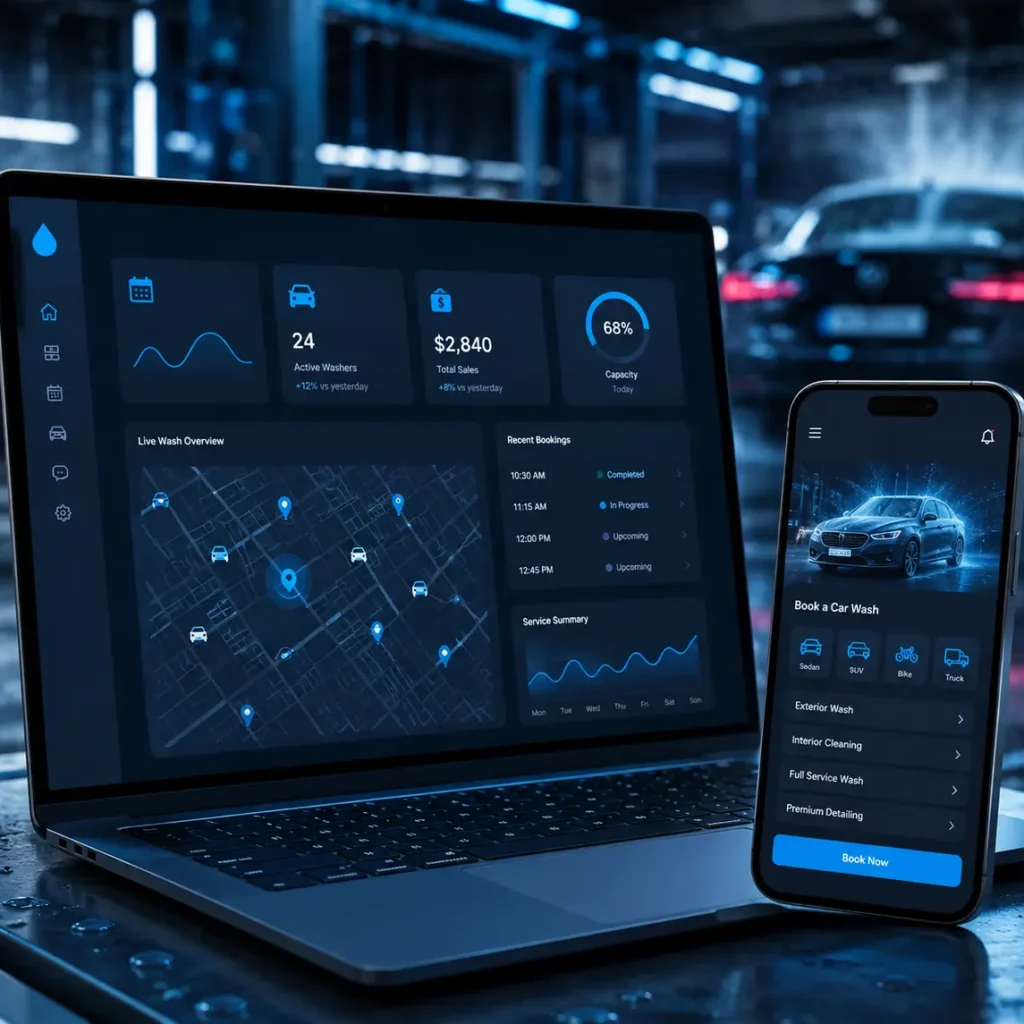
Build the Car Wash Platform Around Real Capacity
Map service models, locations, bays or washers, memberships, payments, integrations, and exception states before the interface promises availability to customers.
Car Wash App Development Process
Model the Business
Define fixed-site, mobile, detailing, membership, marketplace, multi-location, or hybrid operations along with users, locations, services, revenue flows, and the first release boundary.
Map Capacity and the Service Lifecycle
Document how services consume bays, lanes, staff, travel time, equipment, or other capacity and how a booking moves from selection through confirmation, check-in, service, completion, payment, and history.
Verify Integrations and Data Ownership
Confirm payments, CRM, POS, accounting, maps, membership tools, notifications, branch systems, check-in technology, and which system remains authoritative for each record.
Design Role-Specific Experiences
Create customer, washer, site, franchise, support, and administration workflows around the actions and information each role genuinely needs.
Build and Validate High-Risk Flows
Develop mobile and web interfaces, backend services, APIs, integrations, permissions, memberships, payments, and operational states while testing capacity conflicts and exception handling early.
Launch With Operational Visibility
Prepare production monitoring, support procedures, integration alerts, payment reconciliation, analytics, release controls, and an improvement roadmap based on real booking and service behavior.
Test the Operating Model, Not Only the Screens
Booking and Capacity
Test concurrent bookings, service-duration rules, unavailable bays or washers, branch closures, timezones, rescheduling, cancellations, and the point at which capacity is actually reserved.
Membership Entitlements
Test new plans, renewals, failed billing, grace periods, vehicle changes, visit limits, upgrades, pauses, cancellations, cross-location rules, and duplicate entitlement events.
Mobile Worker Operations
Test assignment, route context, arrival, service start, evidence uploads, progress, completion, reassignment, low connectivity, and customer communication for doorstep or marketplace models.
Payments and Refunds
Test successful charges, timeouts, duplicate callbacks, deposits, credits, partial refunds, full refunds, recurring billing, invoices, and reconciliation with the underlying booking or membership.
Permissions and Multi-Location Access
Verify that staff cannot view or modify customers, bookings, payments, memberships, or configuration outside their authorized site, franchise, provider organization, or platform role.
Integration and Recovery
Simulate provider outages, stale location or membership data, notification failures, changed identifiers, API timeouts, duplicate events, and delayed callbacks so the product fails predictably and can recover.
What Shapes Car Wash App Scope and Cost?
A universal car wash app price is not useful because a single-site booking app, mobile-detailing platform, multi-location membership product, and marketplace have very different responsibilities. Scope should be estimated after the business model and integration dependencies are understood.
Business Model
Fixed-site booking, doorstep service, detailing, subscription, franchise, marketplace, or a hybrid model changes the user roles, capacity logic, location rules, and financial workflows.
Applications and Roles
Customer, washer, site, branch manager, franchise, support, and platform administration interfaces increase design, workflow, testing, and permission scope.
Capacity and Scheduling
Simple slots are less complex than bay or lane limits, travel windows, worker assignment, queue estimates, vehicle-specific duration, or multi-resource scheduling.
Memberships and Payments
Recurring billing, vehicle-linked plans, usage limits, credits, deposits, refunds, commissions, payouts, invoices, and reconciliation can materially change the backend design.
Integrations
Payments, CRM, POS, accounting, mapping, notifications, branch software, check-in hardware, or third-party membership systems add dependencies that should be validated before committing a delivery plan.
Locations and Scale
Multiple branches, franchises, providers, service areas, currencies, languages, regional rules, higher booking volume, analytics, and support workflows increase platform complexity beyond the initial customer app.
How to Evaluate a Car Wash App Development Partner
Business-Model Understanding
The team should be able to explain how fixed-site, mobile, detailing, membership, multi-location, and marketplace models change the architecture rather than proposing one generic on-demand template.
Capacity Logic
Ask how the system determines real availability and prevents overbooking across bays, lanes, workers, service duration, location rules, and operational closures.
Membership and Payment Ownership
The provider should explain how entitlements, renewals, failed payments, usage, refunds, credits, payouts, and transaction reconciliation will remain consistent.
Failure-State Design
A credible plan should cover late workers, no-shows, site closures, weather disruption, capacity conflicts, payment uncertainty, stale integration data, and notification failure before launch.
Integration Boundaries
The team should identify which systems remain authoritative for customers, memberships, payments, site operations, and accounting, then design APIs around that ownership.
Evidence and Claims
Evaluate the provider on relevant mobile, backend, payments, marketplace, scheduling, multi-role, and operational engineering evidence. Generic delivery or automotive projects should not be relabeled as direct car wash proof.
Why Work With Digixvalley for Car Wash App Development?
The useful engineering responsibility in a car wash product sits across customer applications, worker experiences, branch or admin workspaces, backend services, payments, memberships, integrations, operational state, testing, and ongoing product evolution. The engagement should begin by clarifying those responsibilities rather than assuming every car wash business needs the same marketplace clone.
Buyers can review our broader software and application case studies for transferable product-engineering evidence. Any adjacent booking, logistics, marketplace, payments, or operations project should be treated as transferable software experience rather than presented as a direct car wash case study unless company-owned evidence confirms that domain.

Explore Our Profiles, Reviews, and Case Studies
Before starting review Digixvalley public profiles, case studies, and project experience to understand how we approach mobile app design, development, backend engineering, testing, and long-term support.
Clutch
Top 1000 CompaniesINC. 5000
America’s Fastest Growing CompaniesDot Comm
Excellence in Web Creativity & Digital CommunicationExpertise
Best Mobile App DeveloperSoftware World
Top App Development CompaniesHorizon Award
Gold Awards WinnerRank Watch
Top Web Development AgenciesHorizon Award
Silver Awards WinnerLatest Insights
CEO, Digixvalley
CEO, Digixvalley
Eguide
App Monetization Strategies: How to Make Money From an App?
Let’s Hear What Our Clients Say


Frequently Asked Questions
Car wash app development is the design and engineering of mobile, web, backend, and integration systems used to discover, book, operate, pay for, and manage vehicle washing or detailing services. Depending on the business model, the platform can include customer, washer, branch, provider, membership, and administration workflows.
Common models include fixed-site booking apps, doorstep or mobile car wash platforms, auto detailing apps, multi-location or franchise systems, subscription and membership products, and marketplaces connecting customers with independent wash providers.
A useful first release often needs vehicle profiles, service packages, location or service-area selection, capacity-aware booking, payments, booking status, notifications, receipts, service history, and operational tools for staff or providers. Membership products may also need recurring billing, entitlement, usage, renewal, and plan-management workflows.
Car wash apps focus on repeatable wash and detailing packages, bay or washer capacity, memberships, subscriptions, service areas, queues, and completion. Car service apps usually go deeper into inspection, repair estimates, approvals, parts, technicians, work orders, and durable maintenance records. The search intent and operating workflows should remain separate.
Yes. A hybrid platform can support physical locations and mobile teams, but the scheduling model must distinguish bay or lane capacity from worker availability, travel time, service areas, arrival rules, and location-specific services.
Yes. The product can manage plan eligibility, recurring billing, vehicle association, usage, renewals, pauses, upgrades, cancellations, credits, and location rules when those commercial policies are defined. Payment status and service entitlement should be modeled separately so exceptions can be handled correctly.
Yes, when the existing systems provide suitable interfaces or integration methods. The project should identify the source of truth for customers, bookings, memberships, payments, and financial records, then define synchronization, retries, error handling, and reconciliation.
The main cost drivers are the business model, number of applications and roles, capacity and scheduling complexity, memberships, recurring billing, payments, marketplace or franchise requirements, locations, integrations, analytics, AI, testing depth, and ongoing operational requirements.
Choose a partner that can explain capacity, booking ownership, membership rules, payment behavior, multi-location permissions, failure states, integrations, and testing. Evidence should match the software responsibilities being commissioned rather than rely on generic on-demand app claims.
Build the Car Wash Platform Around the Service You Actually Deliver
Define locations, capacity, workers, memberships, payments, integrations, and exception rules before committing development budget or promising instant availability.